
Lassoism.com - Ted Lasso Blog
Review: Ted Lasso Season 4 Episode 1 'Home' - A Warm, Inevitable Homecoming
August 10, 2026 - Lassoism.com Editor
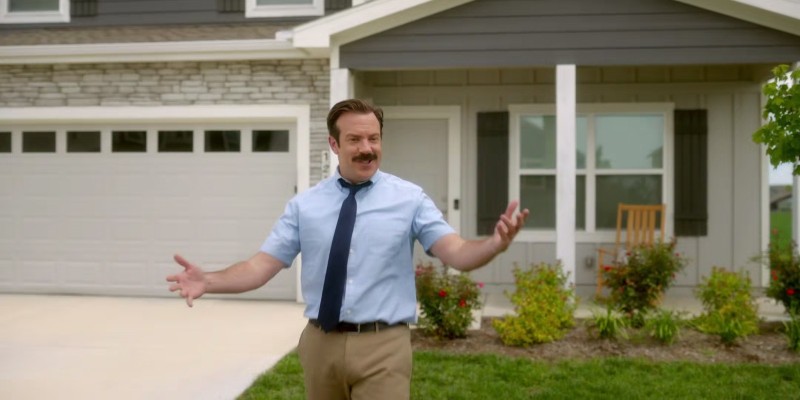
Ted: Rebecca and Keeley in Kansas. Higgins in shorts. Oh, my! (Ted Lasso/Warner Media)
Three years after Ted Lasso walked away from AFC Richmond and the Premier League in a carefully crafted farewell, Apple TV+ has brought the mustachioed optimist back for Season 4. The premiere episode, titled “Home” and released August 5, 2026, picks up years later in Kansas City (or is it Missouri?) the show itself leans into the local confusion. Written by Joe Kelly and directed by Declan Lowney, the 42-minute episode functions less as a pure restart and more as a gentle, character-driven bridge: a reintroduction to Ted’s life after the whistle, a reunion with familiar faces, and the setup for his next chapter coaching Richmond’s new women’s team, the Lady Greyhounds.
It is exactly the kind of episode "Ted Lasso" does best—heartfelt, lightly comic, and emotionally direct—while also revealing the inherent risks of resurrecting a story that once felt complete.
We find Ted (Jason Sudeikis) working as an assistant manager at a high-end grocery store, ringing up customers, dispensing gentle life lessons, and still radiating that signature positivity. He is present for his son Henry (now played by a slightly older Grant Feely), shares an easy, amicable dynamic with ex-wife Michelle, and appears, on the surface, content. Yet the episode quickly establishes an undercurrent of restlessness. Ted is no longer coaching Henry’s youth team, citing the difficulty of mixing the roles of dad and coach. He gets distracted by nearby soccer games. Old acquaintances remind him of the impact he once had. Even simple moments—like a school misunderstanding involving Public Enemy lyrics in Henry’s notebook—highlight how Ted’s mind still drifts toward the pitch.
The arrival of Rebecca Welton (Hannah Waddingham), Keeley Jones (Juno Temple), and Leslie Higgins (Jeremy Swift) upends this carefully constructed domesticity. They have flown in under the pretense of researching a successful women’s club (the Kansas City Current and its purpose-built stadium), but the real purpose is clear: they want Ted to build the “Richmond Way” culture for the Lady Greyhounds. Rebecca is characteristically honest about her motives this time around—“Last time, I hired you for the wrong reasons. This time, I want to hire you for the right ones”—while the group’s fish-out-of-water adventures in the Midwest (barbecue mishaps, sequined shopping, museum visits, jet-lag gags) supply the expected laughs.
Sudeikis slips back into Ted with effortless warmth; the performance still feels lived-in rather than performed. Waddingham, Temple, and Swift bring their familiar chemistry, and the episode uses their presence to catch viewers up on intervening years without heavy exposition dumps. Keeley and Roy are “really, really good friends.” Rebecca is in the honeymoon phase with her Dutch partner Matthijs. Higgins remains the lovable everyman. There are quiet, effective callbacks—Richmond memorabilia in Ted’s home office, a father’s old plaque, a single tea bag gifted with the note “Let It Steep”—that land with genuine sentiment.
Thematically, “Home” leans hard into its title. Rebecca’s parting observation—“Sometimes, home is just a state of mind”—becomes the episode’s thesis. Ted’s Kansas life prioritizes family presence after years of absence, yet the episode gently interrogates whether that presence has come at the cost of purpose. Parallel threads about underdogs (a moving visit to the Negro Leagues Baseball Museum, the structural challenges facing women’s football) reinforce the show’s longstanding interest in building something meaningful against the odds. The episode avoids the title sequence until the very end, a structural choice that signals the story is only truly beginning once Ted makes his choice.
The central dramatic question, "will Ted return?," is one most viewers already know the answer to. That inevitability is both a strength and a limitation. The episode spends much of its runtime letting Ted resist, then quietly unravel his own resistance, culminating in a late-night text exchange that resolves the family-versus-career tension more conveniently than some may prefer. The fish-out-of-water comedy can feel broad, and the premiere is unapologetically setup-heavy; larger ensemble members (Beard, Roy, the new coaching staff and players) are absent, and only teased.
Still, the emotional mechanics work. Small details—a garage-sale conversation with Ted’s mother, the tea-bag gesture, the accidental involvement of Henry in the decision—carry surprising weight. Early critical response has been largely positive (individual scores clustering around 4/5 or higher, with an IMDb user average near 7.8), praising the return of the show’s signature tone even as some note the manufactured quality of certain plot turns.
This is a major, intentional through-line for the episode (and the season). Jason Sudeikis has described the premise explicitly: “What if you had the Tin Man, Cowardly Lion, and Scarecrow go to Kansas to bring Dorothy back to Oz?”
Rebecca, Keeley, and Higgins travel to Kansas to recruit Ted (the Dorothy figure) back to Richmond. The episode title itself (“Home”) and Rebecca’s key line—“Sometimes home is just a state of mind”—play directly on the film’s central theme.
Specific visual and stylistic nods include Keeley’s outfit (pigtails, a checkered/gingham-style dress, and glittery red shoes that evoke Dorothy’s look). The series has long woven in "Wizard of Oz" references (Ted’s Kansas roots, prior pinball machines, red sneakers, “no place like home” motifs, etc.), and this premiere continues and inverts that tradition by having the “Oz” characters come to Kansas.
In the final scene Ted drinks from a mug emblazoned with the logo of "The Wiz."
There are more pointed, scene-specific references. Ted has a "Casablanca" poster hanging near his front door. Dialogue allusions appear during the Gates Bar-B-Q sequence and especially the airport/tarmac farewell scene, where Ted attempts a "Casablanca" quote (Rebecca doesn’t fully clock it). The structure of the goodbye on the tarmac—Ted choosing between two places/homes he loves—echoes the film’s famous ending.
We detail the Casablanca references here: Season 4 Episode 1 'Home' References to the 1942 film 'Casablanca'.
“Home” is not the boldest or most surprising episode of "Ted Lasso", but it is a comforting, well-crafted one. It reminds us why the series earned its devoted following: earnest performances, sincere emotion, and a belief that kindness and underdog spirit still matter. By the time Ted’s decision is made and the familiar theme begins to play, the episode has done its job—reacquainting us with these characters and pointing them (and us) toward Richmond once more.
Season 4 has the harder task of proving the revival was more than nostalgia. On the evidence of this premiere, the foundation is solid, the heart is intact, and the whistle is ready to blow again. For longtime fans, it feels good to be back. For everyone else, it remains an easy, open invitation to believe.
Our Rating: 8/10
It is exactly the kind of episode "Ted Lasso" does best—heartfelt, lightly comic, and emotionally direct—while also revealing the inherent risks of resurrecting a story that once felt complete.
A Life of Quiet Unfulfillment
We find Ted (Jason Sudeikis) working as an assistant manager at a high-end grocery store, ringing up customers, dispensing gentle life lessons, and still radiating that signature positivity. He is present for his son Henry (now played by a slightly older Grant Feely), shares an easy, amicable dynamic with ex-wife Michelle, and appears, on the surface, content. Yet the episode quickly establishes an undercurrent of restlessness. Ted is no longer coaching Henry’s youth team, citing the difficulty of mixing the roles of dad and coach. He gets distracted by nearby soccer games. Old acquaintances remind him of the impact he once had. Even simple moments—like a school misunderstanding involving Public Enemy lyrics in Henry’s notebook—highlight how Ted’s mind still drifts toward the pitch.
The arrival of Rebecca Welton (Hannah Waddingham), Keeley Jones (Juno Temple), and Leslie Higgins (Jeremy Swift) upends this carefully constructed domesticity. They have flown in under the pretense of researching a successful women’s club (the Kansas City Current and its purpose-built stadium), but the real purpose is clear: they want Ted to build the “Richmond Way” culture for the Lady Greyhounds. Rebecca is characteristically honest about her motives this time around—“Last time, I hired you for the wrong reasons. This time, I want to hire you for the right ones”—while the group’s fish-out-of-water adventures in the Midwest (barbecue mishaps, sequined shopping, museum visits, jet-lag gags) supply the expected laughs.
Charm, Callbacks, and the Question of Home
Sudeikis slips back into Ted with effortless warmth; the performance still feels lived-in rather than performed. Waddingham, Temple, and Swift bring their familiar chemistry, and the episode uses their presence to catch viewers up on intervening years without heavy exposition dumps. Keeley and Roy are “really, really good friends.” Rebecca is in the honeymoon phase with her Dutch partner Matthijs. Higgins remains the lovable everyman. There are quiet, effective callbacks—Richmond memorabilia in Ted’s home office, a father’s old plaque, a single tea bag gifted with the note “Let It Steep”—that land with genuine sentiment.
Thematically, “Home” leans hard into its title. Rebecca’s parting observation—“Sometimes, home is just a state of mind”—becomes the episode’s thesis. Ted’s Kansas life prioritizes family presence after years of absence, yet the episode gently interrogates whether that presence has come at the cost of purpose. Parallel threads about underdogs (a moving visit to the Negro Leagues Baseball Museum, the structural challenges facing women’s football) reinforce the show’s longstanding interest in building something meaningful against the odds. The episode avoids the title sequence until the very end, a structural choice that signals the story is only truly beginning once Ted makes his choice.
The Limits of Inevitability
The central dramatic question, "will Ted return?," is one most viewers already know the answer to. That inevitability is both a strength and a limitation. The episode spends much of its runtime letting Ted resist, then quietly unravel his own resistance, culminating in a late-night text exchange that resolves the family-versus-career tension more conveniently than some may prefer. The fish-out-of-water comedy can feel broad, and the premiere is unapologetically setup-heavy; larger ensemble members (Beard, Roy, the new coaching staff and players) are absent, and only teased.
Still, the emotional mechanics work. Small details—a garage-sale conversation with Ted’s mother, the tea-bag gesture, the accidental involvement of Henry in the decision—carry surprising weight. Early critical response has been largely positive (individual scores clustering around 4/5 or higher, with an IMDb user average near 7.8), praising the return of the show’s signature tone even as some note the manufactured quality of certain plot turns.
The Wizard of Oz
This is a major, intentional through-line for the episode (and the season). Jason Sudeikis has described the premise explicitly: “What if you had the Tin Man, Cowardly Lion, and Scarecrow go to Kansas to bring Dorothy back to Oz?”
Rebecca, Keeley, and Higgins travel to Kansas to recruit Ted (the Dorothy figure) back to Richmond. The episode title itself (“Home”) and Rebecca’s key line—“Sometimes home is just a state of mind”—play directly on the film’s central theme.
Specific visual and stylistic nods include Keeley’s outfit (pigtails, a checkered/gingham-style dress, and glittery red shoes that evoke Dorothy’s look). The series has long woven in "Wizard of Oz" references (Ted’s Kansas roots, prior pinball machines, red sneakers, “no place like home” motifs, etc.), and this premiere continues and inverts that tradition by having the “Oz” characters come to Kansas.
In the final scene Ted drinks from a mug emblazoned with the logo of "The Wiz."
References to Casablanca
There are more pointed, scene-specific references. Ted has a "Casablanca" poster hanging near his front door. Dialogue allusions appear during the Gates Bar-B-Q sequence and especially the airport/tarmac farewell scene, where Ted attempts a "Casablanca" quote (Rebecca doesn’t fully clock it). The structure of the goodbye on the tarmac—Ted choosing between two places/homes he loves—echoes the film’s famous ending.
We detail the Casablanca references here: Season 4 Episode 1 'Home' References to the 1942 film 'Casablanca'.
Verdict
“Home” is not the boldest or most surprising episode of "Ted Lasso", but it is a comforting, well-crafted one. It reminds us why the series earned its devoted following: earnest performances, sincere emotion, and a belief that kindness and underdog spirit still matter. By the time Ted’s decision is made and the familiar theme begins to play, the episode has done its job—reacquainting us with these characters and pointing them (and us) toward Richmond once more.
Season 4 has the harder task of proving the revival was more than nostalgia. On the evidence of this premiere, the foundation is solid, the heart is intact, and the whistle is ready to blow again. For longtime fans, it feels good to be back. For everyone else, it remains an easy, open invitation to believe.
Our Rating: 8/10