Lassoism.com - Ted Lasso Blog
Review: Ted Lasso Season 4 Episode 7, "Yes & Baby,"
September 21, 2026 - Lassoism.com Editor
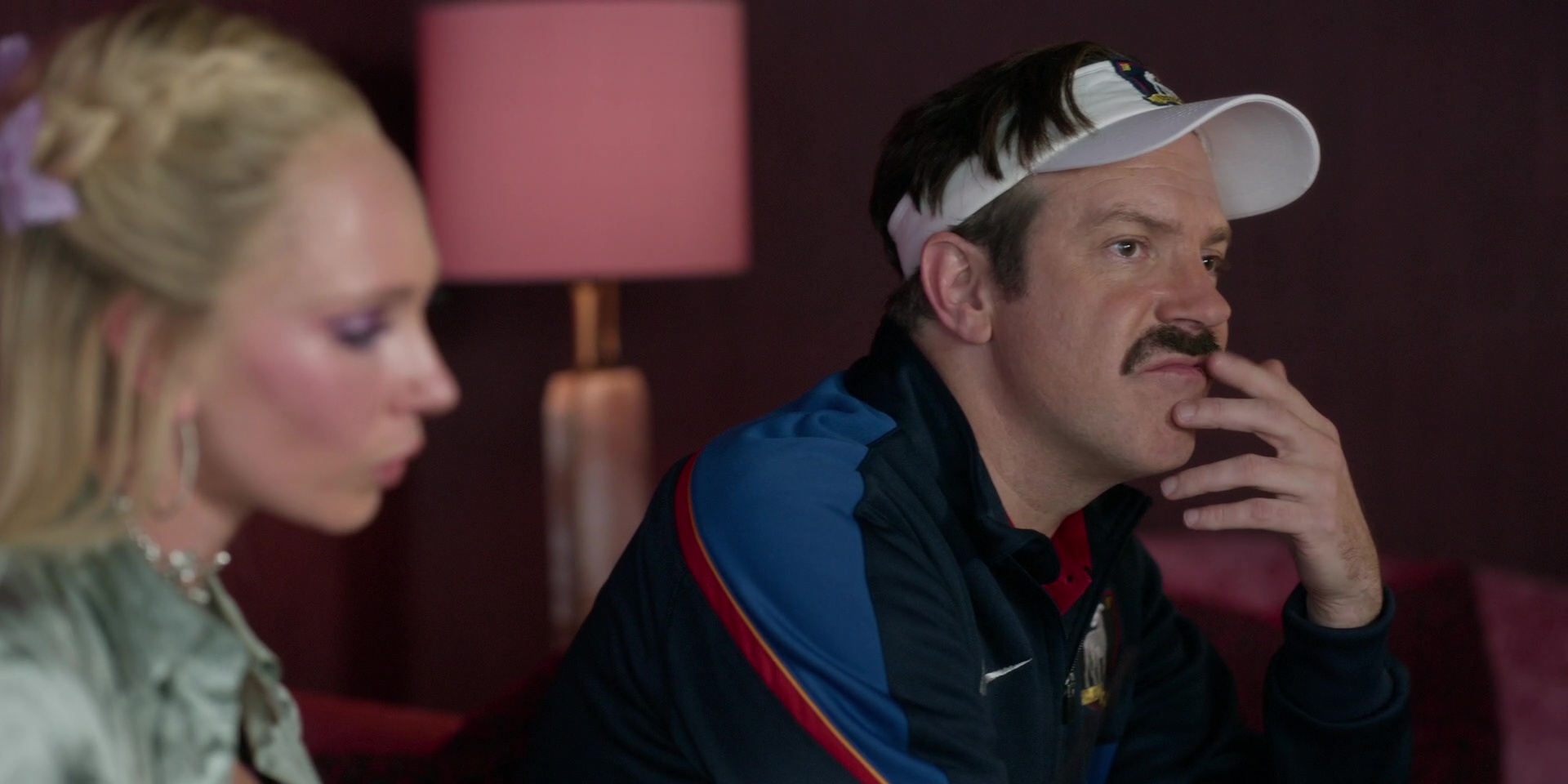
Ted: You know what, I'm starting to think I may skew a bit loquacious. (Ted Lasso/Warner Media)
Ted Lasso Season 4 Episode 7, "Yes & Baby," is the season's most grounded hour — and one of its best.
After a few episodes that leaned on spectacle (a big match, a boat party, holiday high drama), this installment scales back and remembers what the show does best: let people bump into ordinary problems and figure out how to live with them. Written by Jane Becker and Bill Wrubel and directed by Erica Dunton, the 41-minute episode aired September 16, 2026, on Apple TV. It is not a masterpiece, and it still carries some of Season 4's recurring tics. It is, however, the first episode in a while that feels like Ted Lasso instead of a cover version of it.
The opening montage is the episode's smartest move. One by one, the players wake up to the realities of second-division women's football: Lizzie's ex flakes on childcare; Gemma's law internship interview clashes with training; Siobhan and Niamh face another rent hike; Boots' truck dies; Shannon is still doing food delivery; Margy and Mady match with each other on Bantr after taking a break. Almost everyone says "shit." The word becomes a motif, and it works because it is not a punchline. It is just the weather.
That is the point. Belief is easier when you are well paid, well housed, and not also packing lunches or interviewing for a day job. The Lady Greyhounds do not get that luxury. "Yes & Baby" finally treats them as a team with lives instead of a concept the legacy characters orbit.
Coach Alice Chilton, back after her suspension, tries to reset by following a self-help clip that tells her to say yes more. She does. Practice promptly becomes chaos: late arrivals, a child in the locker room, Boots training barefoot. Ted and Beard intervene with the improv rule that gives the episode its title — not just "yes," but "yes, and" (Beard's version: "yes, and baby"). The joke is light. The idea is not. Alice learns that openness without structure is just another form of avoidance.
The "Believe" sign, made by Michelle and hung by Ted, does not land the way it once did. The women call it hollow. Belief does not pay rent. Alice's solution — a Post-it that turns the slogan into "Believe and Win," read aloud by Lizzie's son Archie, who until then did not appear able to read — is a little tidy, even maudlin. It is also effective. The show has always been willing to go for the lump in the throat. Here, at least, the lump is earned by the hour that precedes it.
Ted decides he is ready to date and asks Keeley to help him build a Bantr profile. He freezes on the three-word self-description. Their workshop is the episode's most purely Ted Lasso stretch — rapid, specific, occasionally cringe, often funny. He lands on "I am lovable," deletes the app anyway, and goes to the theater to ask out the still-unnamed stage manager (Charlotte Riley). She is seeing someone she met online. She would have said yes if she weren't. Ted still forgot to ask her name. Progress without a prize. That feels right for this version of the character.
Roy's story is quieter and better than it has been. Dr. Erin Beaumont ends their relationship after realizing — and saying out loud — that Roy is still in love with Keeley. The scene is adult, unshowy, and more moving than the underwritten romance that preceded it. Erin tells him he is worthy of the person he actually wants. Keeley, separately, gets a similar speech from Ted: she deserves to be fully seen. The Roy/Keeley reunion is now clearly coming. The episode is honest enough not to rush it.
Rebecca and Higgins deal with Dani Rojas's agent, Derrick Tarp, who tries to leverage a fake offer to extract more money (partly for Roy). Zelda Southport (Tracey Ullman) joins the call in a ridiculous accent as "Dolly Partonberg," helps expose the bluff, and walks away with an official advisory role at the club. The sequence is broad and very funny. It also continues Season 4's habit of solving institutional problems with a guest-star flourish rather than with Keeley, whose portfolio keeps shrinking while she helps everyone else with their feelings.
Beard, rejected at Zelda's New Year's party for being "too old," shows up in blue contacts and a spray tan, then quietly retreats. He weeps while reading Charlotte's Web to Archie. The gag is small. The bruise underneath it is not.
The episode works because it is modest. After weeks of the show straining for event television, "Yes & Baby" is content to be a workplace comedy about people who are tired. Alice's arc is the cleanest: she does not need a speech; she needs a better verb. Ted's three words are the most honest thing he has said about himself this season. The women's team, at last, has texture.
The weaknesses are familiar. Some jokes land with a thud (the dating-profile bit overstays; a couple of "woke" gags feel like the writers high-fiving themselves). The "Believe and Win" payoff is convenient. Roy and Erin's breakup carries more weight than the relationship was given on screen. And the men's club still occupies a surprising amount of oxygen for a season supposedly about the Lady Greyhounds.
Critics mostly agreed it was a rebound. Vulture gave it four stars and called it a welcome change of pace. TV Fanatic praised the Keeley/Ted workshop. Other reviews landed in the 7.5–8 range, noting that the hour understands what these players carry into training better than the season has so far. That consensus feels correct.
"Yes & Baby" does not reinvent Ted Lasso. It remembers it. Saying yes is easy. Saying yes and — adding a condition, a boundary, a next step — is the actual work. Alice learns that on the training ground. Ted learns it in a theater lobby. The team learns it when they refuse to treat belief as a poster.
If the last three episodes of the season can keep this scale and this attention to the women actually playing the games, Season 4 may yet justify its return. For one night, at least, Richmond felt like a club again instead of a reunion tour.
Our Ranking: 8 out of 10
After a few episodes that leaned on spectacle (a big match, a boat party, holiday high drama), this installment scales back and remembers what the show does best: let people bump into ordinary problems and figure out how to live with them. Written by Jane Becker and Bill Wrubel and directed by Erica Dunton, the 41-minute episode aired September 16, 2026, on Apple TV. It is not a masterpiece, and it still carries some of Season 4's recurring tics. It is, however, the first episode in a while that feels like Ted Lasso instead of a cover version of it.
A day in the life of the Lady Greyhounds
The opening montage is the episode's smartest move. One by one, the players wake up to the realities of second-division women's football: Lizzie's ex flakes on childcare; Gemma's law internship interview clashes with training; Siobhan and Niamh face another rent hike; Boots' truck dies; Shannon is still doing food delivery; Margy and Mady match with each other on Bantr after taking a break. Almost everyone says "shit." The word becomes a motif, and it works because it is not a punchline. It is just the weather.
That is the point. Belief is easier when you are well paid, well housed, and not also packing lunches or interviewing for a day job. The Lady Greyhounds do not get that luxury. "Yes & Baby" finally treats them as a team with lives instead of a concept the legacy characters orbit.
Coach Alice Chilton, back after her suspension, tries to reset by following a self-help clip that tells her to say yes more. She does. Practice promptly becomes chaos: late arrivals, a child in the locker room, Boots training barefoot. Ted and Beard intervene with the improv rule that gives the episode its title — not just "yes," but "yes, and" (Beard's version: "yes, and baby"). The joke is light. The idea is not. Alice learns that openness without structure is just another form of avoidance.
The "Believe" sign, made by Michelle and hung by Ted, does not land the way it once did. The women call it hollow. Belief does not pay rent. Alice's solution — a Post-it that turns the slogan into "Believe and Win," read aloud by Lizzie's son Archie, who until then did not appear able to read — is a little tidy, even maudlin. It is also effective. The show has always been willing to go for the lump in the throat. Here, at least, the lump is earned by the hour that precedes it.
The other plots: dating, agents, and unfinished business
Ted decides he is ready to date and asks Keeley to help him build a Bantr profile. He freezes on the three-word self-description. Their workshop is the episode's most purely Ted Lasso stretch — rapid, specific, occasionally cringe, often funny. He lands on "I am lovable," deletes the app anyway, and goes to the theater to ask out the still-unnamed stage manager (Charlotte Riley). She is seeing someone she met online. She would have said yes if she weren't. Ted still forgot to ask her name. Progress without a prize. That feels right for this version of the character.
Roy's story is quieter and better than it has been. Dr. Erin Beaumont ends their relationship after realizing — and saying out loud — that Roy is still in love with Keeley. The scene is adult, unshowy, and more moving than the underwritten romance that preceded it. Erin tells him he is worthy of the person he actually wants. Keeley, separately, gets a similar speech from Ted: she deserves to be fully seen. The Roy/Keeley reunion is now clearly coming. The episode is honest enough not to rush it.
Rebecca and Higgins deal with Dani Rojas's agent, Derrick Tarp, who tries to leverage a fake offer to extract more money (partly for Roy). Zelda Southport (Tracey Ullman) joins the call in a ridiculous accent as "Dolly Partonberg," helps expose the bluff, and walks away with an official advisory role at the club. The sequence is broad and very funny. It also continues Season 4's habit of solving institutional problems with a guest-star flourish rather than with Keeley, whose portfolio keeps shrinking while she helps everyone else with their feelings.
Beard, rejected at Zelda's New Year's party for being "too old," shows up in blue contacts and a spray tan, then quietly retreats. He weeps while reading Charlotte's Web to Archie. The gag is small. The bruise underneath it is not.
What works, and what still doesn't
The episode works because it is modest. After weeks of the show straining for event television, "Yes & Baby" is content to be a workplace comedy about people who are tired. Alice's arc is the cleanest: she does not need a speech; she needs a better verb. Ted's three words are the most honest thing he has said about himself this season. The women's team, at last, has texture.
The weaknesses are familiar. Some jokes land with a thud (the dating-profile bit overstays; a couple of "woke" gags feel like the writers high-fiving themselves). The "Believe and Win" payoff is convenient. Roy and Erin's breakup carries more weight than the relationship was given on screen. And the men's club still occupies a surprising amount of oxygen for a season supposedly about the Lady Greyhounds.
Critics mostly agreed it was a rebound. Vulture gave it four stars and called it a welcome change of pace. TV Fanatic praised the Keeley/Ted workshop. Other reviews landed in the 7.5–8 range, noting that the hour understands what these players carry into training better than the season has so far. That consensus feels correct.
Verdict
"Yes & Baby" does not reinvent Ted Lasso. It remembers it. Saying yes is easy. Saying yes and — adding a condition, a boundary, a next step — is the actual work. Alice learns that on the training ground. Ted learns it in a theater lobby. The team learns it when they refuse to treat belief as a poster.
If the last three episodes of the season can keep this scale and this attention to the women actually playing the games, Season 4 may yet justify its return. For one night, at least, Richmond felt like a club again instead of a reunion tour.
Our Ranking: 8 out of 10