Lassoism.com - Ted Lasso Blog
Review: Ted Lasso Season 4, Episode 8 "Follow the Anger"
September 24, 2026 - Lassoism.com Editor
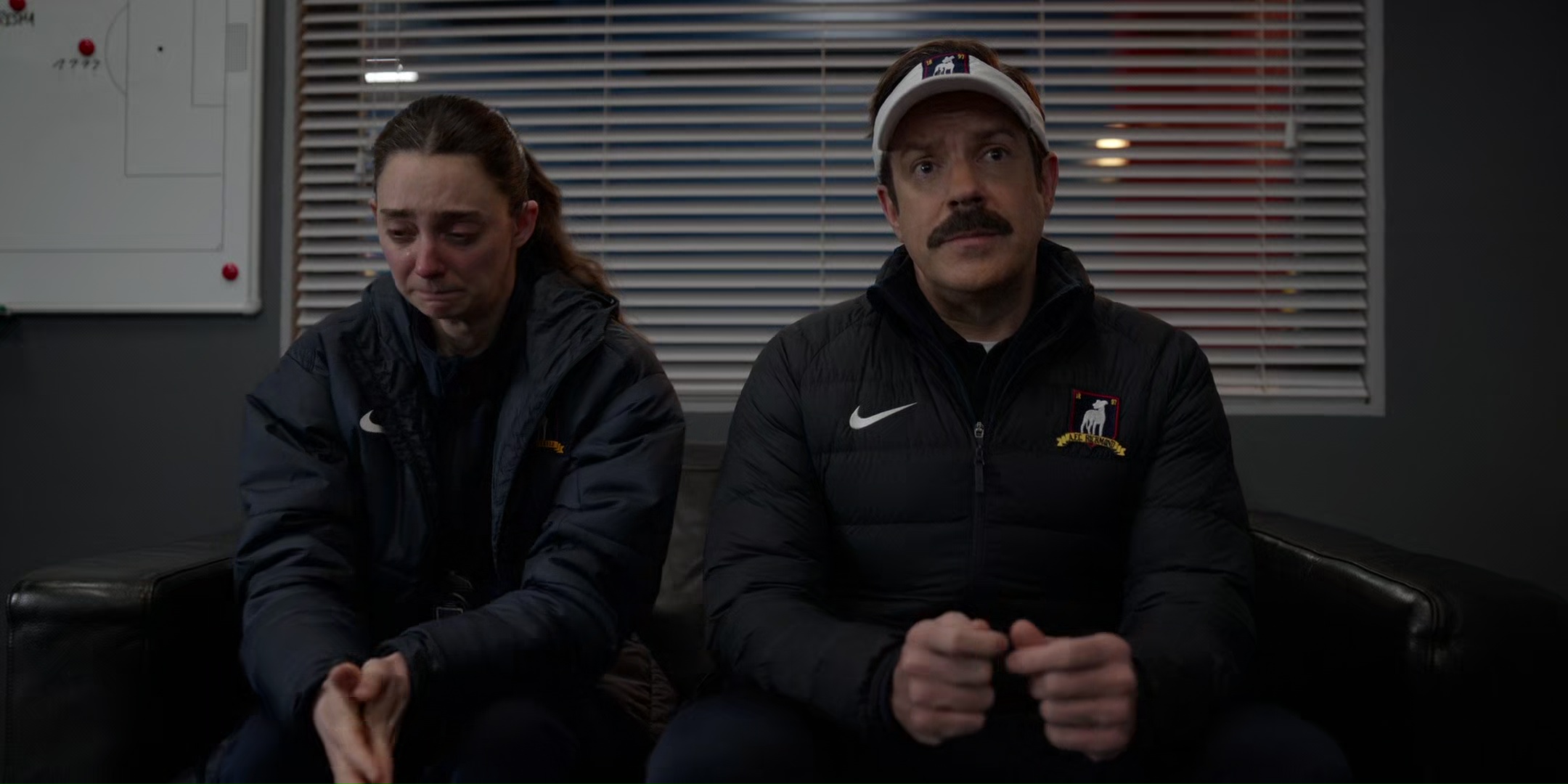
Ted: Tell you what. I'm just gonna sit down right here, okay? (Ted Lasso/Warner Media)
Ted Lasso Season 4, Episode 8 "Follow the Anger" is the season's best so far — messy, sincere, and finally willing to let the show hurt a little.
Officially, it is the episode in which the Lady Greyhounds hit a setback and Roy and Keeley prepare for the Wall of Legends. In practice, it is the first episode this season that feels like classic Ted Lasso without simply repeating it.
Season 4 has spent a lot of time introducing the women's team, establishing Alice (Tanya Reynolds) as a prickly, gifted coach with unfinished business, and circling Roy and Keeley's unresolved feelings. "Follow the Anger" pays some of that off. It also reminds you that the show works best when success is immediately followed by consequence.
The episode opens with a winning-streak montage that should make any Lasso viewer nervous. The locker-room "Believe" sign is now covered in team Post-it notes. Gemma Jay (Abbie Hern) is scoring freely. Then Alice leaves her on for a hat trick instead of substituting her, and Gemma's knee goes. The injury is the engine of the episode: it could sideline her for weeks or, if surgery is required, much longer. It also reopens Alice's own career-ending injury, the wound the season has been circling without fully naming.
That is the episode's best idea. Alice does not get a tidy speech about "learning to believe." She gets a private collapse after a bad practice, and Ted finds her. His one substantial scene is a deliberate inversion of A League of Their Own: there is crying in football. He sits with her. He adds another line to the sign — "AND LET IT OUT." It is corny in the way the show has always been corny, but Tanya Reynolds plays the shame and the relief so cleanly that the moment lands.
Gemma's story is almost as good. She has an internship waiting and a law path that looks safer than a year of rehab. Alice pushes back, then goes to Rebecca. The club commits to her recovery instead of quietly moving on. Gemma stays. It is the kind of institutional care the show has always wanted to believe in, and it works here because the injury is allowed to feel expensive. The team showing up for the MRI is simple and effective.
The Roy and Keeley plot is the one everyone knew was coming. They head to Stamford Bridge for Roy's Wall of Legends induction, miss the ceremony after a cascade of transit disasters, and Roy ends up giving his speech to a nearly empty room. He uses it to tell Keeley he loves her. They get back together. It is shamelessly romantic-comedy structured and, after several seasons of stalling, satisfying. Goldstein and Juno Temple still have the best combative chemistry on the show; the stubbornness, the late arrival, the confession in the wrong room — it is exactly the kind of payoff this pairing needed. Some of the travel bits run long, but the destination is earned.
The third thread is the one that points at the rest of the season. Higgins notices shareholders selling. He investigates in a loose All the President's Men pastiche. Mae, in the Crown & Anchor cellar, tells him to "follow the anger." The trail leads to Rupert. After years offscreen, Rebecca's ex is circling the club again. How the show handles that — especially after Anthony Head's death in June 2026 — is the question hanging over the final two episodes. For now, the name is enough to raise the stakes.
What works: the episode treats anger as information rather than a punchline. Alice's rage, Gemma's fear, Roy's inability to say the simple thing, Higgins following a trail of spite — the title is doing real work. Dunton's direction keeps the three plots from collapsing into each other. The football itself finally matters. And Ted's reduced screen time is a feature; the show is stronger when other people carry the emotional load.
What still nags: the club's initial medical response is sloppy in a way that feels more like plot convenience than institutional critique, even if Keeley correctly flags the sexism. The Roy/Keeley reunion is a little too tidy after all the buildup. And Rupert-as-villain is the most obvious move available. The episode knows that and leans into it anyway.
Critics have mostly treated this as a return to form, some calling it the season's strongest outing — and that feels right. It is not the best episode the series has ever made. It is the first this year that remembers the difference between being nice and being kind, and that kindness sometimes looks like sitting still while someone cries.
Our Ranking: 9/10
Officially, it is the episode in which the Lady Greyhounds hit a setback and Roy and Keeley prepare for the Wall of Legends. In practice, it is the first episode this season that feels like classic Ted Lasso without simply repeating it.
Season 4 has spent a lot of time introducing the women's team, establishing Alice (Tanya Reynolds) as a prickly, gifted coach with unfinished business, and circling Roy and Keeley's unresolved feelings. "Follow the Anger" pays some of that off. It also reminds you that the show works best when success is immediately followed by consequence.
The episode opens with a winning-streak montage that should make any Lasso viewer nervous. The locker-room "Believe" sign is now covered in team Post-it notes. Gemma Jay (Abbie Hern) is scoring freely. Then Alice leaves her on for a hat trick instead of substituting her, and Gemma's knee goes. The injury is the engine of the episode: it could sideline her for weeks or, if surgery is required, much longer. It also reopens Alice's own career-ending injury, the wound the season has been circling without fully naming.
That is the episode's best idea. Alice does not get a tidy speech about "learning to believe." She gets a private collapse after a bad practice, and Ted finds her. His one substantial scene is a deliberate inversion of A League of Their Own: there is crying in football. He sits with her. He adds another line to the sign — "AND LET IT OUT." It is corny in the way the show has always been corny, but Tanya Reynolds plays the shame and the relief so cleanly that the moment lands.
Gemma's story is almost as good. She has an internship waiting and a law path that looks safer than a year of rehab. Alice pushes back, then goes to Rebecca. The club commits to her recovery instead of quietly moving on. Gemma stays. It is the kind of institutional care the show has always wanted to believe in, and it works here because the injury is allowed to feel expensive. The team showing up for the MRI is simple and effective.
The Roy and Keeley plot is the one everyone knew was coming. They head to Stamford Bridge for Roy's Wall of Legends induction, miss the ceremony after a cascade of transit disasters, and Roy ends up giving his speech to a nearly empty room. He uses it to tell Keeley he loves her. They get back together. It is shamelessly romantic-comedy structured and, after several seasons of stalling, satisfying. Goldstein and Juno Temple still have the best combative chemistry on the show; the stubbornness, the late arrival, the confession in the wrong room — it is exactly the kind of payoff this pairing needed. Some of the travel bits run long, but the destination is earned.
The third thread is the one that points at the rest of the season. Higgins notices shareholders selling. He investigates in a loose All the President's Men pastiche. Mae, in the Crown & Anchor cellar, tells him to "follow the anger." The trail leads to Rupert. After years offscreen, Rebecca's ex is circling the club again. How the show handles that — especially after Anthony Head's death in June 2026 — is the question hanging over the final two episodes. For now, the name is enough to raise the stakes.
Conclusion
What works: the episode treats anger as information rather than a punchline. Alice's rage, Gemma's fear, Roy's inability to say the simple thing, Higgins following a trail of spite — the title is doing real work. Dunton's direction keeps the three plots from collapsing into each other. The football itself finally matters. And Ted's reduced screen time is a feature; the show is stronger when other people carry the emotional load.
What still nags: the club's initial medical response is sloppy in a way that feels more like plot convenience than institutional critique, even if Keeley correctly flags the sexism. The Roy/Keeley reunion is a little too tidy after all the buildup. And Rupert-as-villain is the most obvious move available. The episode knows that and leans into it anyway.
Critics have mostly treated this as a return to form, some calling it the season's strongest outing — and that feels right. It is not the best episode the series has ever made. It is the first this year that remembers the difference between being nice and being kind, and that kindness sometimes looks like sitting still while someone cries.
Our Ranking: 9/10